

Table of Contents
- What Sleep Apnea Does to Your Breathing at Night
- Sleep Apnea Symptoms You Can Notice Yourself
- How to Check Your Own Symptoms When You Sleep Alone
- The Sleep Apnea Diagnosis Process, Step by Step
- Home Sleep Apnea Test: What It Measures and Who It Suits
- When to See a Doctor for Sleep Apnea
- Common Mistakes People Make When They Check Themselves
- Conclusion
- Frequently Asked Questions
Last Updated: September 23, 2026
What Sleep Apnea Does to Your Breathing at Night
Sleep apnea is a condition where your breathing stops and starts while you sleep. Each pause can last 10 seconds or longer, and it can happen many times each hour. This guide from CPAP.parts explains the signs to look for and how doctors confirm the condition.
During sleep, the muscles in your throat relax. In obstructive sleep apnea, these muscles block your airway. Air cannot pass, so your blood oxygen level drops. Your brain then wakes you briefly to restart breathing. You may not remember these wake-ups, but they break your sleep into short pieces.
This pattern repeats through the night. The result is poor sleep quality, even after eight hours in bed.
MedlinePlus sleep apnea overview
Sleep Apnea Symptoms You Can Notice Yourself
The signs of sleep apnea fall into two groups: what happens at night and what you feel during the day. Most people notice one or two signs first. Others hear about it from a partner.
Keep a simple record for one week. Note your bedtime, wake time, and how you feel each morning. This record helps your doctor later.
Night-time Signs: Snoring, Gasping and Pauses
Loud snoring is the most common sign. Not everyone who snores has sleep apnea, but most people with the condition snore. The snoring is often loud enough to disturb a partner in another room.
Watch for these night-time signs:
- Breathing pauses that a partner notices
- Nocturnal gasping or choking sounds
- Restless sleep with frequent turning
- Waking up with a dry mouth
- Needing the toilet several times a night (nocturia)
A partner who shares your bed is the best observer. Ask them to note what they hear and see.


Daytime Signs: Tiredness, Headaches and Poor Focus
Daytime somnolence is the feeling of being very sleepy during the day. You may fall asleep while reading, watching television, or sitting in traffic. This is more than normal tiredness.
Other daytime signs include:
- Morning headache that fades after an hour
- Morning xerostomia, or a dry mouth and throat
- Trouble concentrating at work
- Daytime irritability and low mood
- Short sleep latency, meaning you fall asleep within minutes
Chronic fatigue that does not improve with more sleep deserves a doctor’s visit.
How to Check Your Own Symptoms When You Sleep Alone
You can still gather useful information if you sleep alone. Start with a simple morning check.
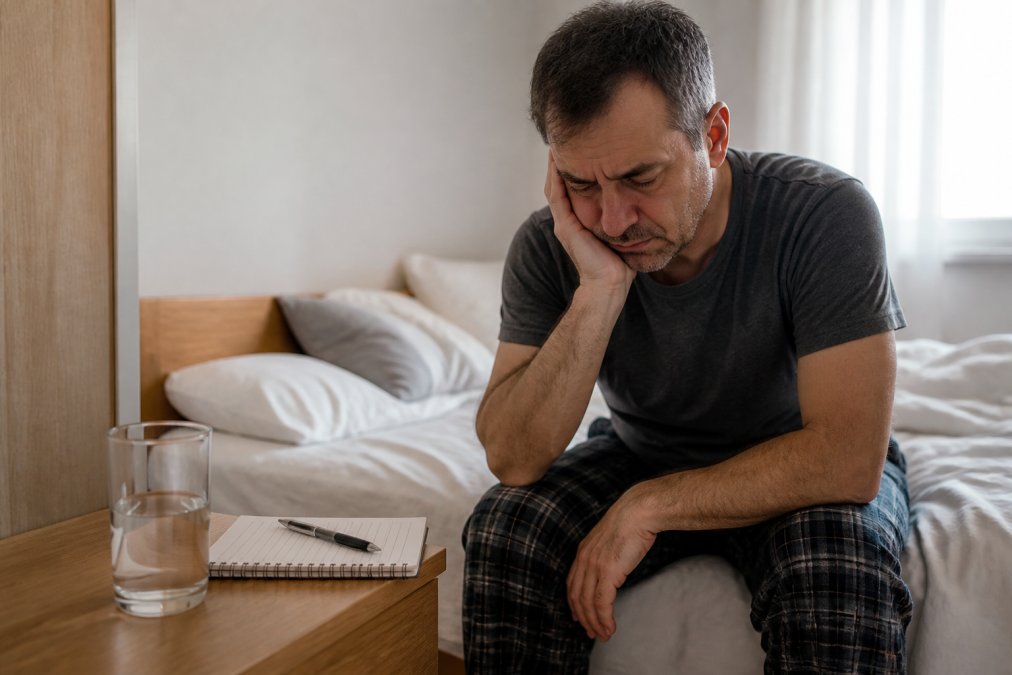
Try these steps:
- Write down your bedtime and wake time each day.
- Rate your morning energy from 1 to 10.
- Note any headache, dry mouth, or sore throat.
- Record how often you wake during the night.
- Note if you feel sleepy while driving or at work.
Score Your Risk with STOP-BANG
The STOP-BANG questionnaire is a short screening tool. It asks eight questions. Each question gives one point. A score of 3 or more means you have a higher risk. A score of 5 or more means you have a high risk. The letters stand for:
- S, Do you snore loudly?
- T, Do you feel tired during the day?
- O, Has a doctor seen that you stop breathing in sleep?
- P, Do you have high blood pressure?
- B, Is your body mass index over 35?
- A, Are you older than 50?
- N, Is your neck circumference more than 40 cm?
- G, Are you male?
Women Often Show Different Signs
Most symptom lists describe the classic male pattern: loud snoring and witnessed pauses. Women often show a different pattern. A common pattern in women is:
- Trouble falling asleep or staying asleep (insomnia)
- Morning headaches
- Low mood or anxiety
- Tiredness that does not improve with rest
- Waking up often during the night
Use a Wearable as a First Clue
A phone app records sound. A wearable records blood oxygen and movement. Use both to build a clearer picture for your doctor.
A self-assessment score is a starting point, not an answer. Only a doctor can confirm sleep apnea.
The Sleep Apnea Diagnosis Process, Step by Step
The sleep apnea diagnosis process starts with your doctor and ends with a sleep study. No single test confirms the condition on its own.
High quality sleep study at home →
Here is how the process usually works:
- Doctor visit. You describe your symptoms and health history.
- Physical exam. The doctor checks your neck, throat, and nasal passages.
- Screening questionnaire. Tools like STOP-BANG give a risk score.
- Sleep study. This measures your breathing, oxygen, and brain activity.
- Results review. A specialist explains the findings and next steps.
Home Sleep Apnea Test: What It Measures and Who It Suits
A home sleep apnea test lets you sleep in your own bed with a small device. It measures breathing effort, airflow, and blood oxygen. Some devices also record snoring.
What the Test Measures
A home test records three main signals:
- Airflow, how much air moves through your nose and mouth.
- Breathing effort, how hard your chest and belly move.
- Blood oxygen, how much oxygen is in your blood.
Some devices also record body position and snoring sound. The device stores the data. You return the device the next day. A sleep specialist reads the data.
What the Numbers Mean
The test gives an apnea-hypopnea index (AHI). This number shows how many events happen per hour of sleep. An event is a full pause (apnea) or a partial pause (hypopnea). A common guide is:
- AHI under 5, normal range
- AHI 5 to 15, mild sleep apnea
- AHI 15 to 30, moderate sleep apnea
- AHI over 30, severe sleep apnea
Who the Test Suits
A home test suits adults with clear symptoms and no other major health problems. It does not suit people with heart failure, severe lung disease, or suspected central sleep apnea. It also does not suit people who need to know their sleep stages.
Home Test vs. Lab Study
A full sleep study in a lab, called polysomnography, records more data. It tracks sleep stages, body position, and limb movements. A lab study also has a technician who watches the recording all night. Doctors use a lab study when the home test gives unclear results or when another condition is possible.
| Feature | Home Test | Lab Study |
|---|---|---|
| Where you sleep | Your own bed | Sleep lab |
| Signals recorded | Airflow, effort, oxygen | Full set, including brain waves |
| Sleep stages | No | Yes |
| Technician present | No | Yes |
| Best for | Clear symptoms, no other illness | Unclear results, other conditions |
Home Monitoring Technology
New devices make home screening easier. Smartwatches and smart rings can track blood oxygen and breathing during sleep. These devices are not medical tests. But they can show a pattern that is worth a doctor visit. If your device shows a drop in blood oxygen several times each hour, save the data. Bring it to your doctor.


American Academy of Sleep Medicine
A home test is a screening tool. It does not replace a doctor’s review. Always discuss the results with a sleep specialist.
When to See a Doctor for Sleep Apnea
See a doctor when you have loud snoring plus daytime sleepiness. Do not wait for symptoms to become severe.
Book an appointment if you notice:
- Pauses in breathing that a partner reports
- Falling asleep while driving
- Morning headaches most days
- Waking up choking or gasping
- High blood pressure that is hard to control
Common Mistakes People Make When They Check Themselves
- Ignoring mild signs. Light snoring and slight tiredness still matter.
- Trusting a phone app as a diagnosis. Apps record sound, not breathing effort.
- Skipping the doctor because you sleep alone. A home test works without a partner.
- Blaming age for tiredness. Daytime sleepiness is not a normal part of aging.
- Stopping after one normal night. Symptoms vary from night to night.
Do not use a self-assessment score as a diagnosis. A high STOP-BANG score means you should see a doctor, nothing more. Ignoring this step can delay treatment for years.
Good sleep hygiene helps, but it does not cure sleep apnea. Keep the room dark and cool, and keep a steady sleep schedule. These habits support treatment, not replace it.
Conclusion
Sleep apnea is common, and the signs are easy to miss. Loud snoring, breathing pauses, and daytime tiredness are the main clues. A home test or a lab study can confirm the condition.
Frequently Asked Questions
How can I test myself for sleep apnea?
You cannot confirm sleep apnea on your own. You can record your symptoms for two weeks: snoring, breathing pauses, gasping, morning headaches, and daytime tiredness. A bed partner can report what happens at night. Then take that record to a doctor. The doctor arranges a sleep study, either a home sleep apnea test or polysomnography, to count apneic events and measure oxygen desaturation. Only that test gives a clinical diagnosis.
What is commonly mistaken for sleep apnea?
Several conditions share the same signs. Plain snoring without breathing pauses is one. Insomnia, restless sleep, and chronic fatigue from other causes also look similar. Thyroid problems, anaemia, and depression cause daytime somnolence too. Some medicines increase tiredness. Because these overlap, a doctor must examine you before anyone decides that sleep apnea is the cause of your sleep apnea symptoms.
Can sleep apnea go away by itself?
Obstructive sleep apnea rarely goes away without treatment. Weight loss, sleep hygiene, and avoiding alcohol at night can reduce snoring intensity and apneic events in mild cases. In moderate to severe cases, continuous positive airway pressure or another prescribed therapy is usually needed. Untreated sleep apnea raises cardiovascular risk over time. Speak to a doctor before you stop or change any treatment.
What happens during a home sleep apnea test?
You take the device home and wear it for one night. Sensors record airflow, breathing effort, oxygen desaturation, and apneic events while you sleep. The results go to a doctor who reviews the data. A home sleep apnea test suits adults with clear symptoms and no major heart or lung disease. Your doctor decides if this test fits your case or if you need a full sleep study in a clinic.